Understanding Disposable Temperature Indicator Activation Temperatures For Food Applications
Understanding Disposable Temperature Indicator Activation Temperatures For Food Applications
For companies purchasing disposable temperature indicators, activation temperature is one of the most important technical specifications to consider. Selecting the correct activation temperature ensures that the indicator matches the requirements of the food product, cooking process, and production environment.
Although disposable temperature indicators are simple products, their performance depends on precise temperature calibration, stable materials, and consistent manufacturing processes.
What Is Activation Temperature?
Activation temperature refers to the specific temperature point at which a disposable temperature indicator changes its position and provides a visible indication.
When the product reaches the designed temperature setting, the internal sensing system activates and triggers the pop-up indication.
For food manufacturers, this provides a simple way to identify when a product has reached the intended temperature condition.
Why Activation Temperature Selection Matters
Different food products require different temperature targets. Selecting an unsuitable activation temperature may result in inaccurate product indication or poor application performance.
Professional buyers should consider:
- Food type
- Cooking method
- Production requirements
- Customer expectations
- Final product application
The correct temperature specification helps ensure that the indicator performs according to the customer's production needs.
Common Activation Temperature Models
Disposable temperature indicators are available in different activation temperature ranges to support various food applications.
Common models may include:
- 125°F temperature indicators
- 138°F temperature indicators
- 145°F temperature indicators
- 160°F temperature indicators
- 165°F temperature indicators
- 180°F temperature indicators
- 185°F temperature indicators
Different temperature settings allow manufacturers to select products suitable for different cooking and processing requirements.
Activation Temperature In Poultry Applications
Poultry processing is one of the most recognized applications for disposable temperature indicators.
Turkey and chicken manufacturers often select different temperature specifications depending on:
- Product size
- Cooking process
- Market requirements
- Packaging format
For large poultry processors, consistent activation performance is important because products are produced in high volumes.
Temperature Accuracy And Manufacturing Consistency
Activation temperature alone is not enough. Professional buyers also evaluate activation accuracy.
High-quality disposable temperature indicators are designed to provide consistent activation performance, commonly around ±2°F accuracy.
Manufacturing consistency depends on:
- Precise material control
- Stable production processes
- Quality inspection procedures
- Reliable component assembly
For industrial customers, consistency across large quantities is essential.
Custom Activation Temperature For OEM Projects
Many food companies require customized temperature specifications for their own products.
OEM customization may include:
- Custom activation temperatures
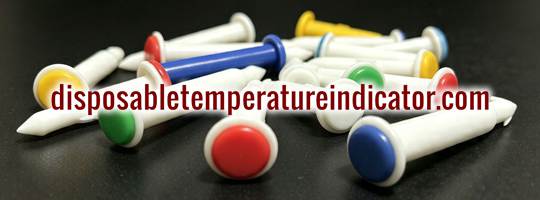
- Specific color identification
- Private label packaging
- Product branding
Customization allows food manufacturers and distributors to develop products that match their specific applications.
Materials Behind Reliable Temperature Activation
The activation process depends on the interaction between multiple components.
Professional disposable temperature indicators commonly use:
- Food-grade PA66 Nylon housing
- Food-grade PA66 Nylon internal components
- Food-derived sensing wax
- Metal spring mechanism
- BPA-Free construction
Careful material selection helps maintain reliable activation performance during food applications.
How Buyers Should Select The Right Temperature Model
Before ordering, buyers should provide information about their intended application.
Useful details include:
- Food product type
- Cooking method
- Target temperature
- Packaging requirements
- Expected order quantity
A professional manufacturer can help customers select the most suitable specification.
Frequently Asked Questions
What does activation temperature mean?
Activation temperature is the temperature point where a disposable temperature indicator triggers its visual indication.
Can activation temperature be customized?
Yes. OEM manufacturers can provide customized activation temperature options for different applications.
What activation temperatures are commonly available?
Common models include different temperature settings such as 125°F, 138°F, 145°F, 160°F, 165°F, 180°F, and 185°F.
Why is temperature accuracy important?
Accurate activation helps food manufacturers achieve consistent production results.
Are disposable temperature indicators suitable for poultry products?
Yes. They are widely used in turkey, chicken, and other poultry applications.
Can different colors represent different temperatures?
Yes. Color customization can help identify different temperature specifications.
How do manufacturers maintain temperature consistency?
Through controlled materials, production processes, and quality inspection.
Can bulk buyers request customized models?
Yes. Bulk OEM customers can request customized specifications and packaging.
DISCLAIMER
"Pop-Up Timer", "Disposable Temperature Indicator", and related terms are generic industry descriptions for single-use temperature indication products. We are an independent Chinese direct-source manufacturer specializing in disposable pop-up timers and temperature indicators since 2006. We are not affiliated with VOLK or any other brands. Any references are used only for product identification, technical explanation, and professional B2B communication.