How Activation Temperature Is Selected for a Disposable Temperature Indicator
How Activation Temperature Is Selected for a Disposable Temperature Indicator
Activation temperature is one of the most important specifications when selecting a disposable temperature indicator for food applications. A product may look simple, but the temperature at which the indicator activates determines whether it is appropriate for a particular cooking or processing application.
For food manufacturers, poultry processors, meat companies, and procurement teams, choosing the correct activation temperature should therefore be part of the product specification from the beginning.
This guide explains what activation temperature means, why different food applications require different settings, and what buyers should discuss with a disposable temperature indicator manufacturer before placing a bulk or OEM order.
What Is Activation Temperature?
Activation temperature is the predetermined temperature at which a temperature-sensitive disposable indicator begins its designed indication process.
In a pop-up timer thermometer, the temperature-sensitive sensing system responds to heat and releases or moves the indicator mechanism. The visible pop-up action provides a simple indication that the product has reached its specified activation point.
The activation temperature is therefore a fundamental part of the product specification rather than simply a color or model variation.
Why Activation Temperature Matters
Different food products can have different cooking requirements, processing conditions, sizes, and production methods. Using the same temperature indicator for every application may therefore not be appropriate.
A poultry processor, for example, may require a different activation point from a manufacturer producing another type of meat or prepared food product.
Selecting the correct temperature helps manufacturers match the indicator to the intended application and production process.
Common Activation Temperature Options
Disposable cooking temperature indicators can be manufactured with different activation temperatures according to the application.
Examples of commercial temperature settings include:
- 125°F
- 138°F
- 145°F
- 160°F
- 165°F
- 170°F
- 180°F
- 185°F
These temperatures should not be treated as interchangeable. The appropriate specification depends on the food product, cooking process, and requirements of the buyer.
Activation Temperature Is Not the Same as a Cooking Recommendation
One important distinction is that the activation temperature of a disposable temperature indicator is a product specification. It should not automatically be interpreted as a universal cooking recommendation for every food.
Food manufacturers should determine the appropriate target temperature for their own products and processes and then select an indicator that corresponds to that requirement.
This distinction is particularly important when a single use food temperature indicator is incorporated into a commercial product or retail-ready food package.
How Food Manufacturers Select the Right Temperature
1. Identify the Food Product
The first step is to identify exactly what the indicator will be used with.
Common applications include turkey, chicken, poultry, meat, prepared foods, and other protein products.
The product type provides the starting point for determining which activation temperature should be evaluated.
2. Understand the Cooking Process
The cooking method also matters. Oven roasting, commercial cooking, and other processing environments can create different thermal conditions.
The manufacturer should therefore understand how and where the indicator will be installed before recommending or producing a particular specification.
3. Consider Product Size
The size and configuration of the food product can influence how heat moves through the product.
For this reason, buyers should provide useful application information when requesting samples from a disposable temperature indicator manufacturer.
4. Define the Required Accuracy
Once the target activation temperature has been identified, the acceptable activation tolerance should also be discussed.
For commercial applications, an activation accuracy of approximately ±2°F may be specified depending on the product and application requirements.
The important point is that buyers should evaluate both the nominal activation temperature and the expected tolerance rather than considering the temperature number alone.
Why Different Models May Use Different Colors
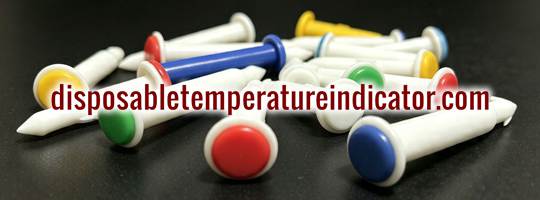
Manufacturers may use different button colors to help distinguish temperature settings during production and purchasing.
Color coding can make it easier for operators and procurement teams to identify different temperature specifications, particularly when several models are used in the same production environment.
For OEM programs, buyers may also request customized colors or other visual identification requirements.
What Happens Inside a Pop-Up Timer Thermometer?
A disposable pop-up timer thermometer uses a temperature-sensitive sensing system together with a mechanical indicator mechanism.
As the surrounding temperature reaches the designed activation point, the sensing material responds and allows the internal mechanism to move.
The process does not require batteries or electronic measurement equipment. The result is a simple visual indication that can be incorporated into a food production or cooking application.
Because the sensing system and mechanical components must work together consistently, activation temperature control is an important part of manufacturing quality.
Materials Can Affect Product Performance
The materials used in a disposable temperature indicator are part of the overall product design.
A commercial indicator may use food-grade PA66 Nylon for the housing and core, a food-derived temperature-sensitive wax system, and a precision metal spring.
The materials, dimensions, sensing system, and assembly process must work together to produce the intended activation behavior.
For this reason, buyers evaluating a food temperature indicator manufacturer should look beyond the finished appearance of the product and ask about the manufacturing process and material specifications.
Activation Temperature and OEM Production
OEM customers often need a temperature indicator designed around a particular product rather than a generic standard model.
A professional OEM disposable temperature indicator supplier may support different activation temperatures for different customer applications.
OEM projects may also involve:
- Custom activation temperature
- Custom button color
- Custom product identification
- Private label packaging
- Bulk packaging
- Retail packaging
Defining the activation temperature early makes the development and quotation process more efficient.
What Buyers Should Ask a Manufacturer
When sourcing a disposable cooking thermometer or temperature indicator, procurement teams should ask several technical questions.
- What activation temperatures are available?
- What is the specified activation tolerance?
- How is activation temperature controlled during production?
- What sensing material is used?
- What food-grade materials are used for the product components?
- Can the activation temperature be customized?
- Can samples be produced for application testing?
- Can the manufacturer support recurring bulk orders?
These questions can help buyers distinguish a specialized manufacturer from a supplier that simply resells standard products.
Why Activation Temperature Should Be Confirmed Before Bulk Production
Once a food manufacturer has selected a temperature specification, it should be confirmed before a large production order is released.
A practical procurement process may include:
- Define the food application.
- Determine the required activation temperature.
- Specify the acceptable tolerance.
- Request representative samples.
- Evaluate the product in the intended application.
- Confirm the final specification.
- Approve packaging and production requirements.
- Proceed with bulk production.
This approach reduces the risk of ordering a visually correct product with an unsuitable activation specification.
Activation Temperature as Part of a Complete Product Specification
Activation temperature should be considered together with the other characteristics of a disposable temperature indicator.
A complete specification can include:
- Product type
- Activation temperature
- Activation accuracy
- Physical size
- Material requirements
- Color
- Application
- Packaging
- Order quantity
- OEM requirements
This gives both the buyer and manufacturer a clear reference for sampling, quotation, production, and future repeat orders.
Frequently Asked Questions
What does activation temperature mean on a disposable temperature indicator?
It is the predetermined temperature at which the temperature-sensitive mechanism activates and produces the intended visual indication.
Can a disposable temperature indicator have different activation temperatures?
Yes. Disposable temperature indicators can be manufactured with different activation temperatures for different food applications.
Can the activation temperature be customized for OEM orders?
Yes. Specialized OEM manufacturers can develop or supply temperature indicators according to specified activation requirements.
How accurate is a disposable temperature indicator?
A commercial product may be specified at approximately ±2°F activation accuracy, depending on the model and agreed manufacturing specification.
Is a disposable pop-up timer the same as a disposable cooking thermometer?
These terms can describe closely related single-use temperature indication products. The exact product specification, activation temperature, and operating principle should be confirmed with the manufacturer.
Who should specify the activation temperature?
The food manufacturer or product owner should determine the required temperature based on its own product and process requirements. The indicator manufacturer can then produce or recommend a suitable specification.
Can bulk buyers order several activation temperatures?
Yes. Buyers with multiple food products or production requirements can source different activation temperatures as separate models or OEM specifications.
DISCLAIMER
"Pop-up timer" is a commonly used descriptive industry term for a type of disposable cooking temperature indicator. It may refer to the functional design or operating principle of such products and does not by itself identify a specific manufacturer or brand.
PopNReady™ is an independent OEM brand of disposable cooking temperature indicators manufactured by LIOU Manufacturing . We are an independent factory-direct manufacturer and are not affiliated with any other brand or manufacturer unless expressly stated.