How Packaging and Product Presentation Affect Disposable Temperature Indicator Selection
How Packaging and Product Presentation Affect Disposable Temperature Indicator Selection
When a disposable temperature indicator is used with a commercial food product, the indicator is not selected independently from the way that product is packaged and presented. Packaging, product position, visibility, and the production process can all influence how the indicator should be specified and used.
This is particularly important for food manufacturers developing packaged poultry, meat, prepared foods, and other products where a temperature-related visual signal needs to remain useful after production.
Why Packaging Matters
Packaging can change how a disposable temperature indicator is installed, viewed, handled, and protected during distribution or cooking.
A product designed for direct cooking may have very different requirements from one that is supplied in a retail-ready package. In one application, the indicator may need to remain clearly visible during cooking. In another, the package may influence where the indicator can be positioned or how easily the activation signal can be seen.
For this reason, packaging should be considered during product development rather than after the temperature indicator has already been selected.
Direct Product Placement vs. Packaged Applications
Some disposable temperature indicators are positioned directly on or within an individual food product. In this type of application, the relationship between the indicator and the food is usually the primary consideration.
Other products may be packaged before or after the indicator is installed. In these cases, the manufacturer must also consider whether the package interferes with installation, visibility, cooking conditions, or the intended visual signal.
The packaging format can therefore become part of the technical application specification.
Visibility Is a Practical Requirement
One of the main advantages of a disposable temperature indicator is that it can provide a simple visual indication. That advantage is reduced if the activation signal cannot be seen easily.
Manufacturers should consider the position of the indicator relative to the package, product surface, labels, trays, films, sleeves, and other packaging components.
If an indicator is intended to be checked by an operator or consumer, the activated and non-activated states should be visually distinguishable under normal use conditions.
This is not simply a design issue. It is part of determining whether the indicator actually performs its intended communication function.
Packaging Should Not Change the Intended Function
A disposable temperature indicator is designed around a specific temperature-response behavior. The surrounding application should therefore be considered carefully when packaging is introduced.
Packaging materials can influence heat transfer and the physical environment around the food product. The manufacturer should evaluate the complete product configuration rather than assuming that an indicator will behave identically in every packaging format.
Application testing can help determine whether the indicator's response remains suitable when the actual package, product, and cooking process are combined.
Retail-Ready Packaging Creates Additional Considerations
Retail-ready food products often require the temperature indicator to work as both a functional component and a visible product feature.
The indicator may need to remain recognizable without interfering with product labeling, graphics, nutritional information, barcodes, or other required packaging elements.
Product developers should therefore determine early whether the indicator will be visible through the package, visible after opening, or intended primarily for use during cooking.
These decisions can influence both indicator placement and packaging design.
Consider Packaging During OEM Development
OEM projects often involve more than changing the logo on a standard product. A food manufacturer may have its own packaging format, product dimensions, color requirements, operating procedure, and consumer presentation.
For this reason, OEM discussions should include application information in addition to branding requirements.
Useful information can include:
- Food product type
- Product dimensions and approximate weight
- Cooking method
- Target activation temperature
- Indicator installation position
- Primary packaging format
- Whether the indicator must remain visible through the package
- Retail or commercial food-service application
- Required logo or private-label treatment
- Expected production volume
Providing this information allows the manufacturer to evaluate the indicator as part of the complete application rather than treating it as an isolated component.
Packaging and Color Selection
Color can also affect the visibility and presentation of a disposable temperature indicator.
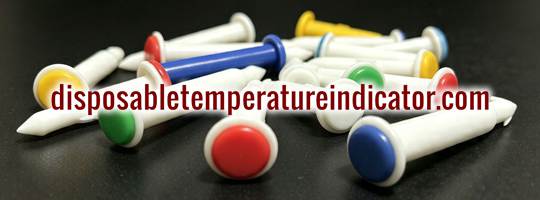
For OEM and private-label applications, manufacturers may want the indicator housing or visible components to coordinate with an established packaging design or brand identity.
However, branding considerations should not compromise the basic visibility of the activation signal. A color that looks attractive on packaging may not necessarily provide the clearest visual distinction during actual use.
Color selection should therefore be evaluated together with the activated and non-activated appearance of the indicator.
Packaging, Installation, and Production Efficiency
In high-volume food manufacturing, the indicator must also fit into the production workflow.
A packaging format that makes manual installation slow or inconsistent may create unnecessary production variation. Manufacturers should consider how operators will handle, position, and inspect the indicator as part of the normal production process.
If an indicator is installed before packaging, the manufacturer should verify that subsequent packaging operations do not displace or damage it. If it is installed after packaging, the process should provide adequate access and visibility.
These practical considerations can become increasingly important as production volume increases.
How Procurement Teams Can Evaluate a Packaged Application
Procurement teams sourcing disposable temperature indicators should provide the supplier with enough information to understand the complete application.
Instead of requesting only a "disposable cooking thermometer," a more useful inquiry can describe the food product, cooking process, packaging format, desired activation temperature, installation method, and required quantity.
The supplier can then determine whether an existing specification is suitable or whether an OEM configuration should be evaluated.
Application Testing Should Include the Final Package
Testing an indicator on an unwrapped product does not necessarily answer every question about a packaged application.
Where packaging is part of the commercial product, qualification should ideally evaluate the actual product and representative packaging configuration under intended cooking or heating conditions.
This can reveal practical issues such as visibility, positioning, handling, and interaction with the production process before the design is introduced into larger-scale production.
Where numerical temperature verification is required during development or process evaluation, suitable temperature-measuring equipment can be used alongside the disposable indicator. The two tools provide different types of information and should not automatically be treated as substitutes.
Common Packaging-Related Mistakes
One common mistake is selecting the temperature indicator first and attempting to design the package around it later. This can create unnecessary limitations in placement and visibility.
Another mistake is evaluating the indicator only under laboratory conditions without considering how the final package will be handled in production, distribution, and cooking.
A third mistake is focusing heavily on branding and appearance while giving insufficient attention to whether the activation signal remains easy to recognize.
Conclusion
Packaging is an important part of disposable temperature indicator selection because it can affect placement, visibility, handling, heat exposure, and production efficiency.
Food manufacturers should therefore evaluate the indicator together with the actual food product, cooking process, packaging configuration, and intended user experience.
For OEM and private-label projects, defining these requirements early can make product development more efficient and reduce avoidable changes later. The strongest solution is not simply an indicator that meets a temperature specification, but one that fits the complete commercial food application.
DISCLAIMER
"Pop-up timer" is a commonly used descriptive industry term for a type of disposable cooking temperature indicator. It may refer to the functional design or operating principle of such products and does not by itself identify a specific manufacturer or brand.
PopNReady™ is an independent OEM brand of disposable cooking temperature indicators manufactured by LIOU Manufacturing . We are an independent factory-direct manufacturer and are not affiliated with any other brand or manufacturer unless expressly stated.