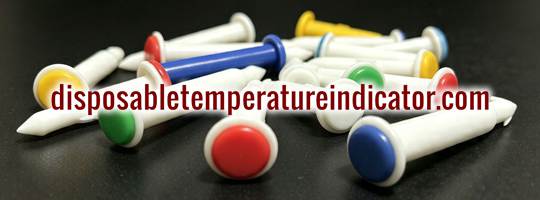
How to Specify a Disposable Temperature Indicator for a Food Product
How to Specify a Disposable Temperature Indicator for a Food Product
Choosing a disposable temperature indicator for a commercial food product is not simply a matter of selecting a temperature number. For food manufacturers, importers, and procurement teams, the specification should match the product, cooking process, packaging format, and intended production volume.
A well-defined specification also makes supplier evaluation easier. Instead of asking several manufacturers for a generic disposable cooking thermometer, buyers can provide a clear set of technical and commercial requirements and compare quotations on the same basis.
This guide explains the main points that should be included when specifying a single use food temperature indicator for poultry, meat, prepared foods, and other commercial applications.
Start With the Food Application
The first question is not which indicator to purchase, but what food product the indicator will be used with.
A poultry processor may require a different solution from a prepared-meal manufacturer or a company selling retail-ready roasting products. The product size, cooking method, packaging format, and target activation temperature can all affect the specification.
Common applications include turkey, chicken, poultry products, meat products, frozen food, ready-to-cook products, and commercial roasting applications.
Define the Required Activation Temperature
Activation temperature is one of the most important specifications for a disposable temperature indicator.
The indicator should be selected according to the intended application rather than simply choosing the most commonly used temperature.
Commercial temperature indicator products can be manufactured at different activation points, including options such as 125°F, 138°F, 145°F, 160°F, 165°F, 180°F, and 185°F.
For an OEM project, the required activation temperature should be clearly stated when requesting samples and quotations. This prevents confusion between visually similar products with different thermal characteristics.
Consider Activation Accuracy
A temperature indicator is useful only when its activation behavior is consistent with its specified temperature.
For commercial applications, buyers should ask the manufacturer how activation accuracy is controlled and what tolerance applies to the finished product. A specification of approximately ±2°F may be suitable for many commercial disposable cooking temperature indicator applications, depending on the customer's requirements.
Procurement teams should also distinguish between the nominal activation temperature and the actual acceptable activation range when reviewing technical documentation.
Select the Appropriate Product Size
The physical size of the indicator can also matter.
Different food products may require different insertion depths or physical configurations. A large poultry product and a smaller individual food item do not necessarily require the same indicator size.
Buyers should therefore provide the manufacturer with information about the product dimensions and intended application before finalizing the specification.
Specify the Materials
Material selection is another important part of a disposable temperature indicator specification, particularly when the product is intended for food applications.
A commercial product may incorporate food-grade PA66 Nylon for the housing and core, a food-derived temperature-sensitive wax system, and a precision metal spring.
Buyers should request clear information about the materials used in the product and the applicable food-contact requirements for their target market.
Decide Whether OEM Customization Is Required
Standard products are suitable for some applications, while branded food products may require a customized solution.
An OEM disposable temperature indicator supplier may provide customization options such as:
- Activation temperature
- Button color
- PANTONE color matching
- Logo injection molding
- Retail packaging
- Private label packaging
- Bulk packaging
It is usually more efficient to define these requirements before production begins rather than treating them as separate changes after the product has already been approved.
Match the Packaging to the Distribution Model
Packaging requirements can be very different for industrial buyers and retail brands.
A food processor purchasing bulk disposable temperature indicators may prefer simple bulk packaging because the indicators will be incorporated into its own production process.
A retail brand, on the other hand, may require blister card packaging, resealable bags, display boxes, or other consumer-facing formats.
Packaging should therefore be included in the initial product specification, especially when requesting an OEM quotation.
Consider the Production Volume
The expected order quantity should be discussed early with the manufacturer.
There is a significant difference between ordering samples, placing a small trial order, and establishing a recurring supply program for hundreds of thousands of units.
For bulk disposable temperature indicators, buyers should ask about:
- Minimum order quantity
- Monthly production capacity
- Standard lead time
- Repeat-order scheduling
- Packaging capacity
- Export experience
These factors help procurement teams determine whether a supplier can support the project after the initial order.
Build a Clear Supplier RFQ
A good request for quotation should contain enough information for a manufacturer to provide a meaningful proposal.
For example, an RFQ for a disposable meat thermometer or poultry temperature indicator can include:
- Food application
- Required activation temperature
- Target accuracy
- Product size
- Color requirements
- Material requirements
- Logo requirements
- Packaging format
- Estimated annual quantity
- Initial order quantity
- Destination market
Providing these details reduces unnecessary quotation revisions and allows different suppliers to be evaluated more fairly.
Do Not Compare Suppliers on Unit Price Alone
A low quotation does not necessarily represent the lowest total sourcing cost.
For a commercial food manufacturer, inconsistent activation, unstable supply, poor packaging, or repeated specification changes can create additional costs that are not visible in the initial unit price.
A better procurement comparison considers the complete supply relationship:
- Product consistency
- Manufacturing experience
- Quality control
- Customization capability
- Production capacity
- Lead time
- Packaging options
- Communication and technical support
Why a Specialized Manufacturer Can Simplify Sourcing
A specialized food temperature indicator manufacturer has direct experience with the product's sensing mechanism, materials, assembly, activation temperature, and production requirements.
This can be particularly valuable when a buyer needs a custom temperature indicator rather than a standard off-the-shelf product.
For long-term B2B supply, direct communication with the manufacturing source can also make specification changes, repeat orders, and production planning more straightforward.
A Practical Specification Checklist
Before approving a disposable temperature indicator, procurement teams can use the following checklist:
- What food product will it be used with?
- What activation temperature is required?
- What activation tolerance is acceptable?
- What product size is appropriate?
- Are food-grade material requirements specified?
- Is OEM or private label customization required?
- What packaging format is needed?
- What quantity will be purchased?
- Can the manufacturer support recurring orders?
- Has the supplier demonstrated suitable production experience?
A clear specification gives both the buyer and manufacturer a much better foundation for developing the correct product.
Frequently Asked Questions
What information should I provide when ordering disposable temperature indicators?
At minimum, buyers should provide the intended food application, activation temperature, approximate quantity, product size requirements, and packaging requirements. OEM projects may also require color and logo specifications.
Can the activation temperature be customized?
Yes. Specialized manufacturers can produce temperature indicators with different activation temperatures for different food applications.
What is a single use food temperature indicator used for?
It provides a visual indication when a food product reaches its predetermined activation temperature and can be used in poultry, meat, roasting, and other food production applications.
Can disposable temperature indicators be supplied in bulk?
Yes. Bulk supply is commonly used by food manufacturers, poultry processors, distributors, and other B2B buyers.
Can a disposable cooking thermometer be customized with a company logo?
OEM manufacturers can offer logo customization and other private label options depending on the product and production requirements.
What should I look for in a disposable temperature indicator manufacturer?
Important factors include specialized manufacturing experience, activation accuracy, material knowledge, OEM capability, production capacity, quality control, packaging options, and the ability to support long-term bulk supply.
DISCLAIMER
"Pop-up timer" is a commonly used descriptive industry term for a type of disposable cooking temperature indicator. It may refer to the functional design or operating principle of such products and does not by itself identify a specific manufacturer or brand.
PopNReady™ is an independent OEM brand of disposable cooking temperature indicators manufactured by LIOU Manufacturing . We are an independent factory-direct manufacturer and are not affiliated with any other brand or manufacturer unless expressly stated.